Mostrando entradas con la etiqueta P8. Mostrar todas las entradas
Mostrando entradas con la etiqueta P8. Mostrar todas las entradas
jueves, 22 de diciembre de 2011

jueves, 15 de diciembre de 2011


martes, 13 de diciembre de 2011
viernes, 9 de diciembre de 2011


miércoles, 7 de diciembre de 2011
domingo, 4 de diciembre de 2011
Planing the Plan
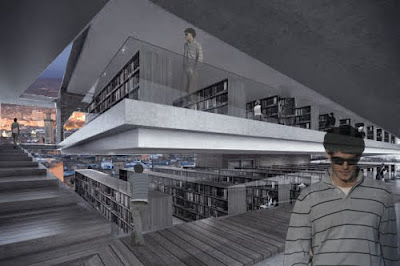
El proyecto comienza con la poética idea de construir una Biblioteca laberinto 
LABYRINTH - N TH LIBRARY
tomando como referencia proyectos literarios de bibliotecas imaginarias como la de Borges "ab aeterno" "una sucesión de espacios ordenados de modo informe y caótico"; la citada por nuestro catedrático en la primera charla descrita por Eco en El nombre de la rosa describiendo la biblioteca como "un gran laberinto, signo del laberinto que es el mundo"; o más recientemente la creada en la imaginación de Zafón: " un laberinto de corredores y estanterías llenos de libros dibujaban una colmena tramada de túneles, escalinatas, plataformas y puentes que dejaban adivinar una gigantesca biblioteca de geometría imposible".
Además esta idea se apoya en la propia configuración de la ciudad de FEZ, cuyas calles conforman un "laberinto de muros verticales" y que representa la cultura matemática e intimista árabe.
Incluso su lenguaje se contorsiona y general laberintos: el Kufi
tomando como referencia proyectos literarios de bibliotecas imaginarias como la de Borges "ab aeterno" "una sucesión de espacios ordenados de modo informe y caótico"; la citada por nuestro catedrático en la primera charla descrita por Eco en El nombre de la rosa describiendo la biblioteca como "un gran laberinto, signo del laberinto que es el mundo"; o más recientemente la creada en la imaginación de Zafón: " un laberinto de corredores y estanterías llenos de libros dibujaban una colmena tramada de túneles, escalinatas, plataformas y puentes que dejaban adivinar una gigantesca biblioteca de geometría imposible".
Además esta idea se apoya en la propia configuración de la ciudad de FEZ, cuyas calles conforman un "laberinto de muros verticales" y que representa la cultura matemática e intimista árabe.
Incluso su lenguaje se contorsiona y general laberintos: el Kufi
Una vez hecho el análisis del terreno con una pendiente difícil de ignorar y en una posición heterotópica de la ciudad se responde con un proyecto intincado que unifica los espacios interconectándoles una y otra vez pero generando recodos que permiten la lectura en una esquina íntima e iluminada.
Se genera un laberinto de recorridos interiores yuxtapuestos pero independientes, claros y prácticos y se proyectan espacios flexibles con paneles móviles: fusuma.
Funcionalmente pese a la compleja apariencia en planta, se resuelve como un edificio estructurado en alas, añadiendo la ventaja de la interconexión de los diferentes espacios, inexistente dentro del tipo.
jueves, 24 de noviembre de 2011
domingo, 30 de octubre de 2011
anagram,organigram&hologram
anagram
type of word play, the result of rearranging the letters of a word or phrase to produce a new word or phrase, using all the original letters exactly once.
 |
| De anagram |
organigram
diagram that shows the structure of an organization and the relationships and relative ranks of its parts.
hologram
domingo, 23 de octubre de 2011
How to express it in words
They say a picture is worth a thousand words... but still words are more liquid and allow us to imagine instead of observe. They allow us to create instead of copy.

So for that I resort to words, language and books....again.
The project of a library in Fez starts with concept of a complex space where is impossible to get lost. The ultimate LABYRINTH in which everything is found and everyone is save and in tune with theirs ninth sense: proprioception- the perception of body awareness.
For me, its the feeling some medieval cities generate in the walker as if you where in a labyrith but never lost. The force guides you as is you were a padawan and the city was your master.
Rely on words.
(...) "After an hour driving we passed Tel aviv and forty minutes later we were arriving and parking the car outside the old city of Jerusalem. You'll be a fool if you think I could express in words how going into that city feels. It is the materialization of chaos, but you never get lost once you are in it: narrow crowded streets full of, it Jesus were alive, bazars and you suddenly find the Holy Temple. If you follow the - always in a hurry, kippá wearing- people you'll get to the Western Wall and if you keep going where tourists begin to disappear into the arabic quarter, then maybe someday will get into the Doom of the Rock. It's like someone is allowing you to step in those streets perturbing its equilibrium and you don't understand why he does.
I've recently learnt an Hebrew expression that is used to name the religious people that become secular. It reads: JAZÁ LE SHEELÁ which means " the one who returned to the question" Jerusalem makes you want to know the answer, even it you've never abandoned the descartian doubt neither intended to. It makes you believe even if it just for just a glance."(...)
The intention is to design a library space that inspires that constant feeling of questioning and fulfills curiosity and wisdom. So you never lose your-self in the labyrinth neither the feeling of returning once and once again to the question:
JAZÁ LE SHEELÁ
viernes, 7 de octubre de 2011
jueves, 6 de octubre de 2011

lunes, 3 de octubre de 2011
jueves, 29 de septiembre de 2011
lunes, 26 de septiembre de 2011
Drawing a bit more.
Keeping the concept. Developing the idea.
The scheme of the building is to combine the spirit of the city and the spirit of the writer in the same house.
Due to the first one, the house is a compact building from the outside while a porous object in the inside, with diagonal linking courtyards. It also presents a landscape and labyrinthine go round as the texts of the city suggested that generate "vertical words only surrounded by walls"
The spirit of the writer is given expression through the use of the KUFI, a form of arabic language as a drawing that is tried to be used as a drawing language as well as building concept. This contributes to the labyrinthine feeling even when the plan is organized with a perimetrical band of services that orders the space. This also enlarges the outside wall benefiting the thermal inertia.
With a programme of a house and two enclosed apartments, the house is a labyrinthine space centered in the LIBRARY, with secret doors, lighted by the courtyard - the scene of a novel.
 |
| De Plano 110919 |
lunes, 19 de septiembre de 2011

jueves, 15 de septiembre de 2011
Building with books

Approach Model (15.09.11)
There are some architectonical interventions that fight on their own, disregarding what it's happening around them. They decide their future in the physical limits of their territory and invest their time imagining the space, interpreting typologies or fitting in the programatic need of such space.
Maybe this should be one of them. Looking into it self rather than around. Cos' what is there to see? Maybe we require more mass and an introspective view. Maybe we should pile the books.


Tridimensional kufi//kufical structure (17.09.11)
martes, 13 de septiembre de 2011
The spirit of the writer
"It takes a thought to make a word and it takes some words to make an action"- Mraz sings in my head as I reflect on language and its influence in the writing process. Words are different in different languages and even when they come from the same thought they still have their own particular nuance.
So maybe, to grasp the spirit of the writer and give expression of it in the action- the design of his house in FEZ- we should research his language, arabic and learn from its alphabet, its structure, its calligraphy...
So, paraphrasing Mraz: It takes some letters to make a word, it takes some words to express an idea and it takes ideas to create whatever. In this case lets use them to design a house for someone who will use them to create stories. That way we will do the work of an architect with the tool of a writer: language.

lunes, 12 de septiembre de 2011
The spirit of the city. FEZ
 |
| De P8.allona |
Site Plan. FEZ. 1:10000
Plot located at the occidental shore of FEZ's river, immersed in the structure of the Medina.
 |
| De P8.allona |
Site Plan. Plot. 1:1000
Designing a house for a writer the concept must come from written text. Given Mosebach's I recover his words about waking though FEZ as walking in "Complete vertical worlds just separated by walls"
Because maktub (it is written in arabic)
miércoles, 7 de septiembre de 2011
PRIMER EJERCICIO.enunciado
Vivienda para un escritor en la Medina. FEZ
(6SEPT-28SEPT)
única condición: ser acompañado por el ensayo de Martín Mosebach- la casa épica.

"Fez es una ciudad de ocultamientos (...) puede que fuera la experiencia del depotismo oriental lo que hiciera aconsejable revelar hacia fuera lo menos posible de la vida familiar."
"El entrar [en una casa en FEZ] siempre va acompañado por la sorpresa: a veces por la fascinación.
En las oscuras callejuelas, la mirada se dirigía al suelo; ahora, de repente, se eleva a las grandes alturas y a la luz. (...) Mucha luz y mucho espacio y una gran altura.(...) Cuando se entra en una de ellas, ante todo se llega al aire libre."
"Recorriendo la ciudad, uno se movía a través de puros mundos verticales sólo separados por paredes."
Suscribirse a:
Entradas (Atom)